

Learning becomes more enjoyable when children can practice new skills while playing with family and friends. Educational board games give kids opportunities to count, recognize words, describe colors, ask questions, and make decisions without turning every activity into a formal lesson. Depending on the game, children can work on fine motor control, language skills, logical thinking, or basic math through simple hands-on challenges.
The right educational board game should match your child’s age, interests, and learning level. Some children may enjoy removing tiny pieces with tweezers, while others prefer guessing characters, matching word tiles, or rolling dice. Group games can also encourage communication and turn-taking, making them useful activities for family game nights, playdates, and quiet afternoons at home.
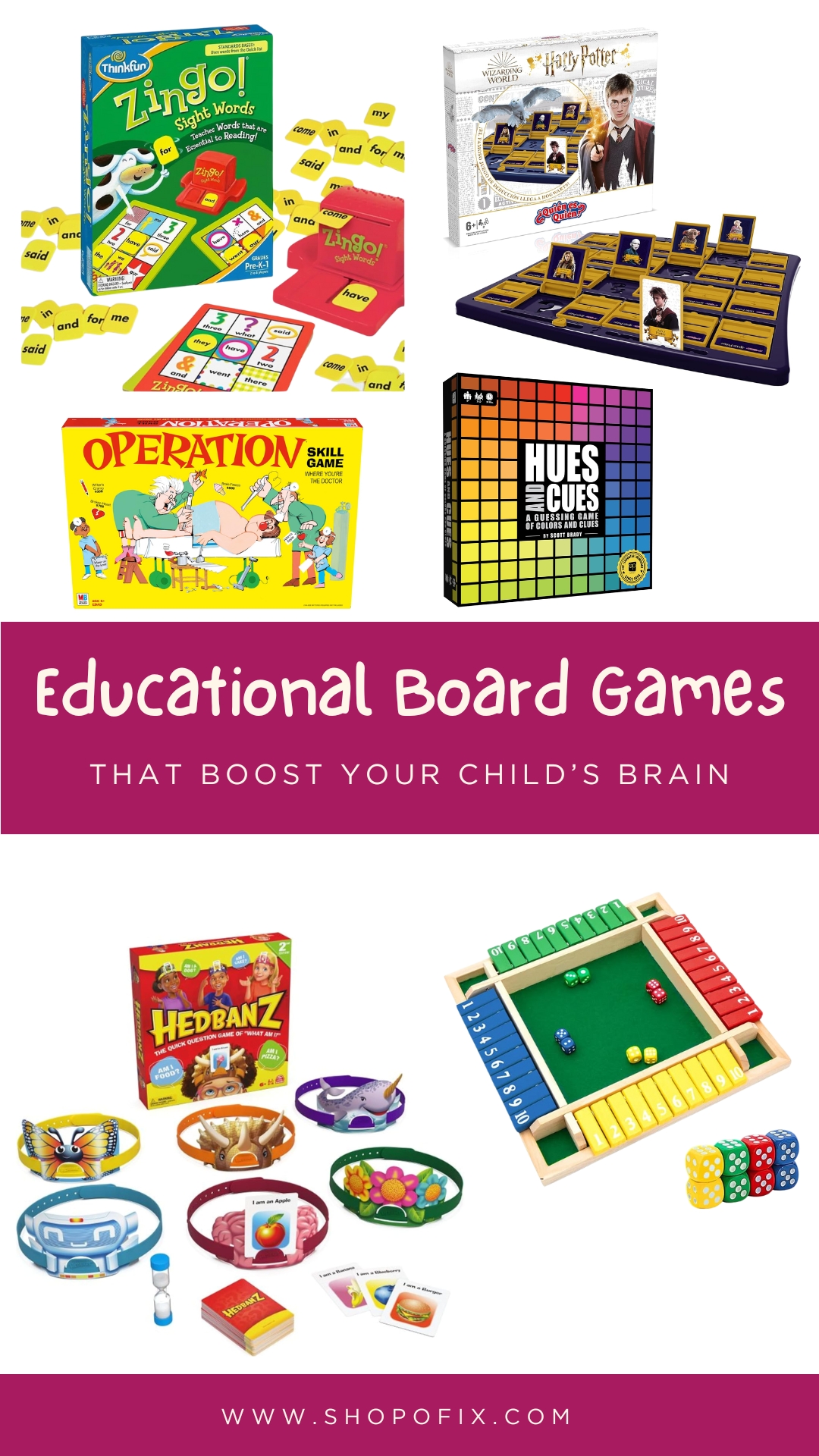
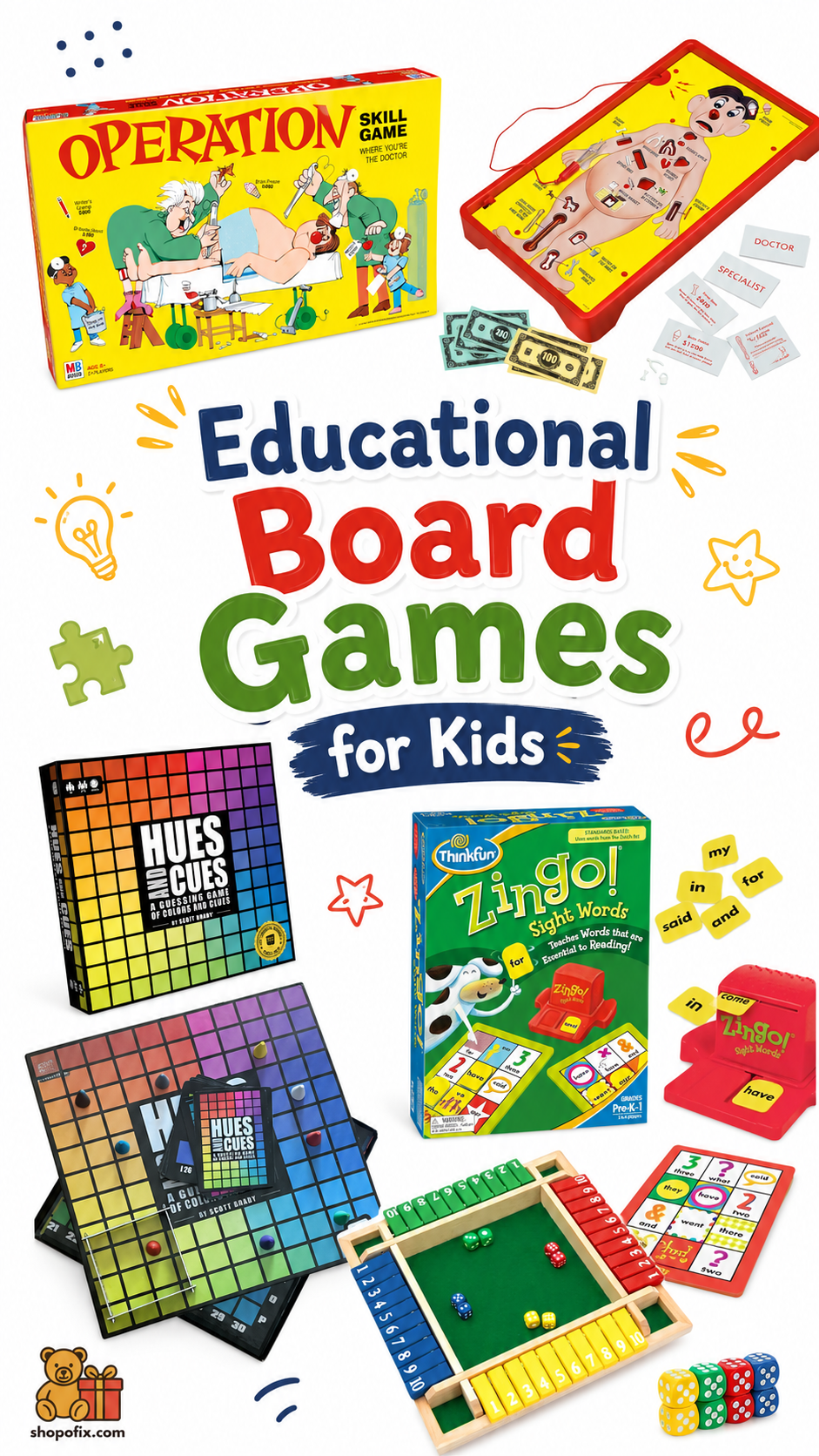
In this guide, we explore six Educational Board Games for Kids with different rules, themes, and learning activities. You will find games for practicing early reading, developing math skills, identifying colors, and improving deductive reasoning. Whether you are looking for a birthday gift or a screen-free learning activity, these options can add variety to your child’s playtime.
Educational Board Games for Kids
Recommendation Products
1. Operation

Playing doctor becomes more interactive with Operation, a classic electronic board game that challenges children to remove different objects from a patient without touching the metal edges. Designed for children aged 6 and older, the game includes a patient game board, 12 funny ailments, tweezers, and a red buzzing nose mechanism. The combination of small pieces and careful movements makes each turn a hands-on activity.
Children need to concentrate as they guide the tweezers around the board and attempt to remove each ailment. This process can encourage hand-eye coordination, careful movements, and patience, while the doctor theme adds a fun element to pretend play. The game also introduces children to simple body-related vocabulary through its playful design, although it should not be treated as a formal medical learning tool.
The electronic features require two standard AA batteries, and the set includes play money and an instruction guide. Parents should keep the small pieces together in a container after play to reduce the chance of losing them. Because the game involves small components, adult supervision is important, especially when younger children are nearby.
- Recommended Product: Operation
2. HUES and CUES

How would you describe a specific shade of blue without showing the exact color? HUES and CUES turns that question into a creative guessing game. Its board contains a grid of 480 different shades, while the clue cards and scoring tokens give players a structure for each round. Players must use words and associations to help others identify the color they have in mind.
The game offers an opportunity to develop descriptive language because players need to explain colors using familiar objects, places, or ideas. One person might connect a shade to a fruit, an item of clothing, or something found in nature, while other players try to find the closest matching tile. There is no single way to describe a color, so the game can lead to different answers and conversations.
With its large color board and group-based format, HUES and CUES is suitable for family gatherings, playdates, and relaxed game nights. Children can practice listening to clues and comparing different shades, while adults can participate without needing complicated preparation. Store the cards and scoring pieces together after use to keep the game organized.
- Recommended Product: HUES and CUES
3. Guess Who is Harry Potter

A guessing game becomes more interesting when children recognize the characters and details from a familiar fantasy world. Guess Who? Harry Potter is a two-player game that uses character cards and game boards with movable sliders. Each player tries to identify the other person’s chosen character by asking questions and eliminating possibilities.
The main activity focuses on observation, comparison, and logical decision-making. Players need to choose questions carefully instead of asking random questions, then use the answers to narrow down the available characters. Questions about appearance, clothing, or other visible details can help children understand how information can be used to reach a conclusion.
The game includes two plastic game bases, character cards, and slider mechanisms for head-to-head matches. Its two-player format makes it convenient for siblings, friends, or a parent and child to play together. The Harry Potter theme may be especially appealing to children who already enjoy the characters, but parents should check the recommended age on the current product listing before purchasing.
- Recommended Product: Guess Who? Harry Potter
4. Spin Master Games Hedbanz

Children who enjoy talking, asking questions, and playing in groups may have fun with Spin Master Games Hedbanz. The game includes six headbands, picture cards, a sand timer, and scoring chips. During each round, players wear a card on their forehead and try to discover what is shown by asking questions to the other players.
Unlike a traditional matching game, Hedbanz encourages children to listen to answers and adjust their next question. They may need to determine whether the picture represents an animal, object, food, or another category before making a guess. This format gives children practice with verbal communication, classification, and basic deductive reasoning in a playful setting.
The adjustable headbands make the game suitable for group sessions, while the timer adds a time-based challenge to each round. Parents can introduce the rules gradually if younger players need additional guidance. The lightweight components also make the game a possible choice for family trips, provided that the cards and accessories are packed securely.
- Recommended Product: Spin Master Games Hedbanz
5. ThinkFun Zingo Bingo

Early word recognition becomes an active game with ThinkFun Zingo Bingo. Rather than drawing cards from a standard deck, players use a mechanical Zinger dispenser to reveal word tiles. The set includes 72 double-sided tiles and six double-sided cards, giving children different ways to match words and pictures during each round.
Children slide the dispenser to release tiles, then check whether the word or image matches something on their card. This matching process can support early vocabulary recognition and attention to printed words, depending on the child’s reading level and the side of the card being used. The dispenser also adds a hands-on step that keeps children involved throughout the game.
Zingo Bingo works well for short group activities because players can take turns revealing tiles and checking their cards. Parents can help children sound out unfamiliar words or explain new vocabulary as they play. Keep the dispenser, tiles, and game cards together after each session so the set is ready for the next activity.
- Recommended Product: ThinkFun Zingo Bingo
6. Nicecho Shut The Box Dice Game

Math practice does not always need worksheets or digital screens. Nicecho Shut The Box Dice Game uses a wooden game structure, numbered sections from 1 to 10, and dice to introduce children to simple addition and number combinations. Its traditional design gives players a straightforward activity that can be played at home or taken along during a family trip.
After rolling the dice, players calculate the total and decide which numbered sections to close. Children can begin with basic addition and gradually try different combinations as they become more comfortable with the rules. The game may also encourage decision-making because players need to consider which numbers to cover during each turn.
The set includes a four-sided felt rolling area, wooden number blocks, and matching dice. The felt surface may help reduce some noise during play, although the actual sound level depends on the playing environment. Parents can adapt the activity to suit a child’s level by helping with calculations or allowing the child to explain how they reached an answer.
- Recommended Product: Nicecho Shut The Box Dice Game
How to Choose the Right Educational Board Game for Kids
Not every educational board game teaches the same skill or offers the same type of play. Before choosing one, consider the following factors.
1. Consider Your Child’s Age and Learning Level
Age recommendations can help parents find a game with suitable rules and components. Younger children may enjoy simple matching activities such as Zingo Bingo, while older children may prefer games that involve deductive questions or more detailed decision-making.
Always check the current manufacturer’s age recommendation, especially when the game includes small pieces, cards, or other components that may not be suitable for very young children.
2. Match the Game to Your Child’s Interests
A game is more likely to hold a child’s attention when its theme matches something they already enjoy.
- Pretend play: Operation introduces a playful doctor theme.
- Colors and descriptions: HUES and CUES focuses on identifying shades through clues.
- Fantasy characters: Guess Who? Harry Potter combines guessing with a familiar fictional theme.
- Talking and group play: Hedbanz encourages players to ask and answer questions.
- Early reading: Zingo Bingo uses word and picture matching.
- Math practice: Shut The Box introduces number combinations through dice.
3. Choose Between Solo, Two-Player, and Group Games
Think about how your child will usually play. Guess Who? Harry Potter is designed for two players, while Hedbanz and HUES and CUES are better suited to group activities. A game that fits your family’s usual playtime can be easier to use regularly.
4. Look at the Physical Components
Board games may contain cards, tokens, dice, tweezers, or small plastic parts. Consider how easy the components are to handle and store. A game with many small pieces may require a storage container, while a compact wooden game or card-based set may be more convenient for travel.
5. Focus on the Learning Activity, Not Only the Label
The term educational does not mean every game teaches academic content in the same way. Some games support vocabulary and communication, while others involve counting, visual comparison, or logical reasoning. Choose an activity that matches the specific skill you want your child to practice.
Educational Board Games Comparison Table
| Board Game | Main Learning Focus | Play Style | Notable Features |
|---|---|---|---|
| Operation | Fine motor control and concentration | Family game | Tweezers, 12 ailments, electronic buzzer |
| HUES and CUES | Color recognition and descriptive language | Group game | 480 shades, clue cards, scoring tokens |
| Guess Who? Harry Potter | Deductive reasoning and comparison | Two players | Character cards and slider boards |
| Spin Master Games Hedbanz | Verbal reasoning and categorization | Group game | Headbands, picture cards, timer |
| ThinkFun Zingo Bingo | Word recognition and matching | Group game | Zinger dispenser, word tiles, grid cards |
| Nicecho Shut The Box | Addition and number practice | Family game | Wooden board, numbered sections, dice |
Final Thoughts
Educational board games can give children a different way to practice important skills while enjoying time away from screens. Operation focuses on careful movements, HUES and CUES encourages color descriptions, and Guess Who? Harry Potter introduces logical questioning. Meanwhile, Hedbanz supports verbal interaction, Zingo Bingo offers word-matching practice, and Shut The Box provides a simple activity based on numbers and addition.
The best choice depends on your child’s interests, age, and preferred play style. A child who enjoys talking may respond well to a guessing game, while another may prefer handling physical pieces or solving number challenges. By introducing different types of games, parents can make family playtime more varied and create opportunities for children to learn through active participation.
Watching young children develop new skills through play can be rewarding for the whole family. If your child is beginning to enjoy group activities and simple tabletop games, you may also want to explore our recommendations for the best board games for 4-year-olds .