


Board games do not always need a winner and a loser. With cooperative board games, children work toward a shared goal, discuss their choices, and learn how their actions affect the whole group. These games can be especially useful for family play because parents, siblings, and children can participate together without focusing only on who finishes first.
The best Cooperative Board Games for Kids offer rules that match a child’s age and attention span. Some involve saving owls before sunrise, solving a mystery, or completing simple activities with colorful game pieces. In this guide, we look at three options for different stages of childhood, from beginner-friendly games for young children to cooperative mystery play for kids who enjoy making decisions together.
Cooperative Board Games for Kids

Recommendation Products
1. Peaceable Kingdom Hoot Owl

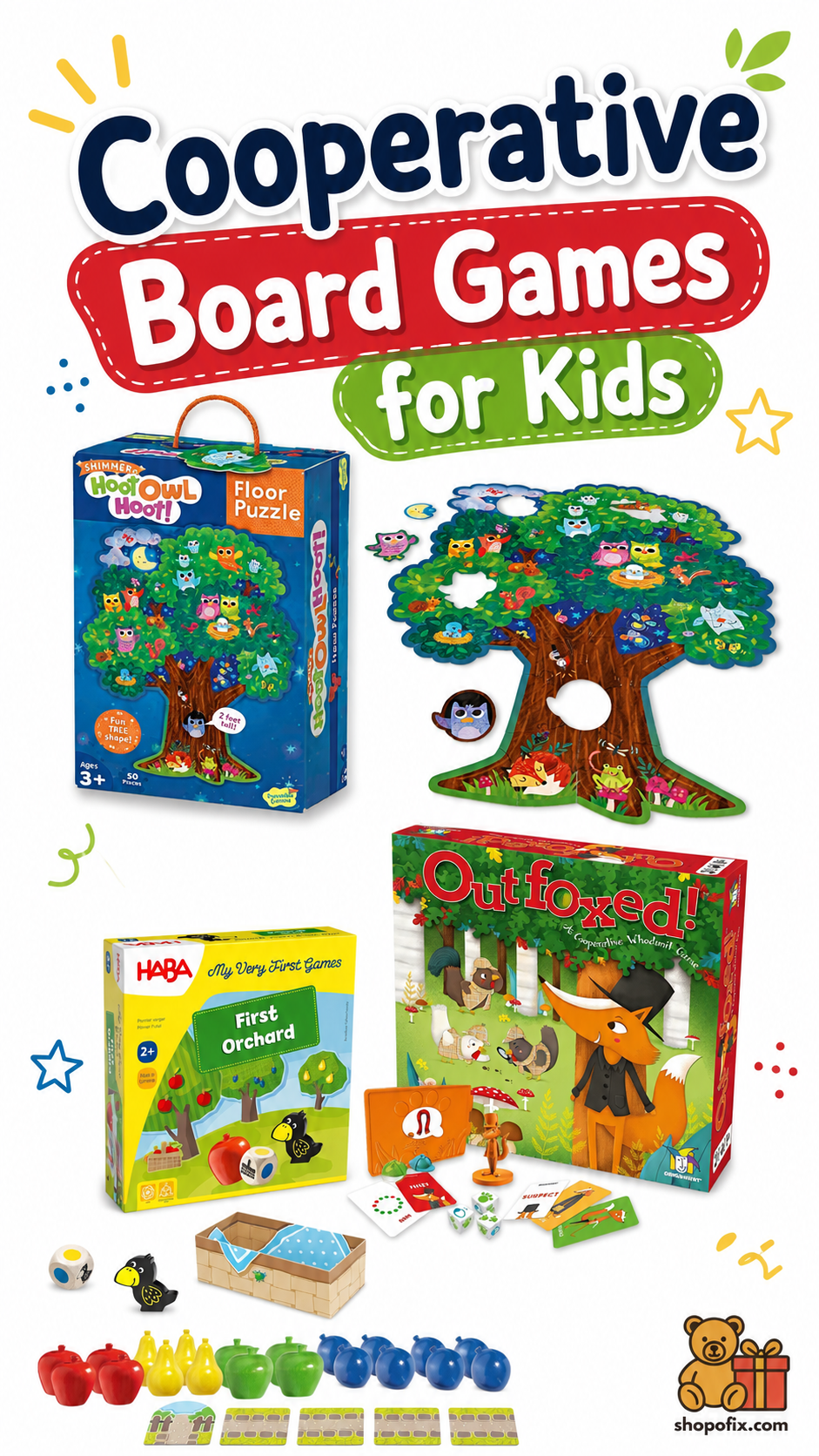
The sun is getting closer, and the owls need to return home before daylight arrives. In Peaceable Kingdom Hoot Owl Hoot!, players work together to help the owl tokens reach their nest before the sun token reaches the end of the board. The shared objective gives children a reason to discuss their next moves instead of concentrating on beating another player.
The game includes a colorful board, owl tokens, a sun token, movement cards, and instructions. Children can take turns drawing and using cards while considering how each move affects the team’s progress. Because everyone is working toward the same outcome, younger players can practice sharing ideas and participating in group decisions without needing to compete against their family members.
Designed for children ages 4 and up, the game can fit into family game nights, preschool activities, or short play sessions at home. Its straightforward format makes it easier for beginners to understand the main objective, although parents may still need to explain the rules and guide younger children through their turns. When the game is finished, return the cards and tokens to the box so the set is ready for the next round.
- Recommended Product: Peaceable Kingdom Hoot Owl
2. OUTFOXED

A missing pie gives the players a mystery to solve, and the fox may escape if they do not work quickly enough. OUTFOXED! turns a board game into a shared investigation, asking children to examine clues, discuss suspects, and use the available detective tools as a team. The experience is different from a typical competitive guessing game because the players are cooperating to identify the guilty fox.
The set includes a game board, suspect cards, clue markers, dice, a clue decoder, an evidence scanner, and instructions. Each component contributes to the investigation, giving children different details to consider during the game. Instead of simply choosing an answer on their own, players can explain why they suspect a particular character and listen to the ideas of other participants.
Suitable for children ages 5 and up, OUTFOXED! may appeal to kids who enjoy mystery stories and deduction activities. The cooperative format also gives parents opportunities to ask questions such as, “What clue should we check next?” or “Which suspect can we rule out?” The game can support group discussion while keeping the central objective clear: find the fox before it escapes.
- Recommended Product: OUTFOXED
3. HABA My Very First Games

For toddlers and preschoolers, a board game needs to be easy to handle and simple enough to follow with adult guidance. HABA My Very First Games offers a collection of early games using components such as sturdy boards, colorful wooden pieces, and large cards. The variety allows families to select an activity that matches the child’s age, interests, and familiarity with game rules.
The wooden pieces are designed to be held by small hands, while the simple activities introduce children to basic game routines. Depending on the specific game in the collection, children may practice matching, recognizing colors, taking turns, or communicating with the adults and children playing alongside them. These activities should be introduced at a comfortable pace, especially when a child is still learning how to follow instructions.
Unlike a single game built around one storyline, a collection gives families different ways to play together. Parents or teachers can choose a shorter activity for a young child’s attention span and gradually introduce other games as the child becomes more familiar with taking turns. Keep the wooden pieces and cards together in the box after play so the set remains organized for future sessions.
- Recommended Product: HABA My Very First Games
How to Choose Cooperative Board Games for Kids
Cooperative games can have very different rules and levels of difficulty. A mystery game that works well for a five-year-old may be too complicated for a toddler, while a very simple matching activity may not hold the attention of an older child. Consider the following points before choosing a game.
1. Match the Game to Your Child’s Age
Age recommendations provide a useful starting point, but children also differ in their ability to follow rules, wait for turns, and understand shared objectives.
- Toddlers and preschoolers: Look for large pieces, simple activities, and short rounds.
- Children ages 4 and up: Games with clear goals and basic turn-taking can introduce cooperative play.
- Children ages 5 and up: Mystery games and clue-based activities may offer more opportunities for discussion and decision-making.
The adult’s role is important, particularly when a child is learning a game for the first time. Explain the rules in simple language and demonstrate one turn before starting.
2. Look at the Shared Objective
A cooperative game should make it clear what all players are trying to achieve. In Hoot Owl Hoot!, the group works to return the owls before daylight. In OUTFOXED!, the players investigate clues to identify the fox.
A clear objective helps children understand why they need to discuss their choices. Before buying, check whether the goal is easy to explain and whether the rules are suitable for the children who will be playing.
3. Consider the Amount of Reading Required
Some games use cards, clues, or instructions that may require reading or adult explanation. Younger children may need a parent or teacher to read the cards and explain what each symbol means.
For toddlers and early preschoolers, games with visual elements and simple instructions may be easier to introduce. Older children may be ready for games that involve more clues, details, or discussion.
4. Check the Playing Time
A long game is not always the best choice for young children. Consider how long a typical round takes and whether the game can be stopped and continued later.
Shorter games may be more manageable for toddlers and preschoolers. Older children who enjoy mystery or strategy activities may be comfortable with a longer session, especially when they can stay involved in the decisions.
5. Choose a Game That Encourages Participation
A cooperative game works best when every player has an opportunity to contribute. Look for activities where children can take turns, suggest ideas, choose cards, move pieces, or help solve a shared problem.
Parents should avoid making every decision for the child. Instead, offer simple questions and allow children to participate at a level that suits their age and understanding.
6. Check Storage and Component Size
Board games usually contain multiple cards, tokens, boards, and other small components. A box with organized storage can make cleanup easier and reduce the chance of losing pieces.
Check the manufacturer’s age guidance for small parts. Store game components safely and supervise young children during play, particularly when the set contains pieces that may not be suitable for their age.
Cooperative Board Games for Kids: Comparison Table
| Product | Main Activity | Suggested Age | Suitable For |
|---|---|---|---|
| Peaceable Kingdom Hoot Owl Hoot! | Helping owl tokens reach home before sunrise | Ages 4 and up | Children learning teamwork and basic cooperative rules |
| OUTFOXED! | Solving a mystery by examining clues | Ages 5 and up | Kids who enjoy detective themes and group discussion |
| HABA My Very First Games | Early games using wooden pieces, boards, and cards | Toddlers and preschoolers, depending on the specific game | Young children learning simple game routines |
Final Thoughts
Cooperative board games give children a different way to experience family game time. Instead of focusing on individual winners, players can work toward a common goal, share suggestions, and practice taking turns. The right game depends on the child’s age, the complexity of the rules, and the type of activity they enjoy.
Peaceable Kingdom Hoot Owl Hoot! is centered on helping the owls reach home, while OUTFOXED! introduces a cooperative mystery with clues and detective tools. HABA My Very First Games offers a collection of early activities for younger children who are beginning to learn how board games work. Before choosing, review the age recommendation and game instructions so the activity matches your child’s abilities and your family’s preferred play style! Take a peek at these wonderful best kids tool bench toys that will keep your little helper happily busy for hours!